
8. Interim Sharing
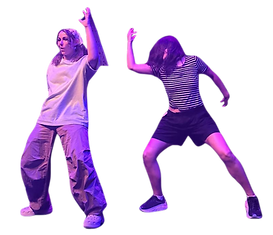
The technical set-up for our interim sharing was intensive and required ongoing negotiation with James, who reluctantly agreed to help us craft a highly aesthetic presentation inspired by imagery from thisispopbaby. True to our process, we were scrambling until the last minute to decide what choreography to include and how to shape the dance sequence. Our anxieties focused less on what we were doing than on how the audience might respond: Would they know what to do? Had we offered enough invitations? Would they feel guided? Would they even like the music?
During the sharing, we did not anticipate how energized the audience would be, especially during this open rave section. They picked up props, tried on costumes, and even began jump-roping with bin bags (to James’s alarm). Although we recognised that this group of ATP students was not necessarily representative of a wider public audience, their willingness to embrace the open dance section surprised us and expanded our sense of what was possible.
The feedback we received helped us interrogate the dynamics of participation. What makes an audience feel part of an event? Does it require physical involvement, dancing, and using objects, or can the act of watching alone suffice? Nohar, for example, said she enjoyed observing and didn’t feel the need to participate actively in the club sequence to remain engaged.
This perspective challenged our assumption that participation was inherently superior. Jacques Rancière reminds us that spectatorship is never passive: watching always involves acts of selection, interpretation, and connection to one’s own experiences (Rancière, 2009, p. 17). Reframing spectating as an active mode of engagement shifted our understanding of the work. Rather than treating watching as a “lesser” experience, we began to recognise it as equally valid.
Tutors also encouraged us to make contradictions within the piece more explicit, to probe beneath the surface of the glittering clubland. Without that, the work risked becoming tone-deaf or just an immersive utopia that ignored our real-world position and context. They asked why is this important now? How does it connect to the wider societal picture? What does it reveal about hope, and what is the function of hope in this space?
This feedback pushed us to seek out vulnerability in the piece, to let the work converse more directly with contemporary realities and the contradictions of club and dance culture. The interim sharing became a turning point, prompting us to search for more depth and nuance in the months that followed.